
Comic Books, Art, Illustration, Writing, Video Games. Creative from Detroit.
Saturday, December 17, 2011
The Honeycomb Hideout Episode 5: "Occupy the Hideout!"
Alright, y'all, the boys are back and they're coming out swinging! Joe, Mark and Nik are covering the whole gamut this time around; the Occupy movement, Frank Miller's fall from grace, the economy, the climate of politics, the popular obsession with cell phone pics and even trends in mainstream rap! There are no punches pulled and no quarter given this episode! Also, we have the debut of a new installment for the show, "BEEF w/ Sanjay". So come on down and hear the fire fly! They break the 2-hour mark on this one, so trust me, there's plenty to hear.
And remember, folks, this is an 18+ adult counter culture podcast, so if you ain't over 18, you shouldn't be listening to it!
Download this episode (right click and save)

Tuesday, December 6, 2011
Tools Of The Trade Part 2
Last time we talked I mentioned a tool called Celtx. Celtx is a script writing software that is free to download and use, but also allows networking features so that your and your collaborators can work together on the same script, for a nominal subscription fee.


In lieu of the subscription fee service provided by Celtx, we here at Imaginos Workshop, opt to use Dropbox, the file archieving and sharing software I spoke about in the last T.O.T.T post. Dropbox and Celtx allowed Nik, who is currently in Chicago, and myself to finish revisions on act one of a script we have most recently been working on.
One of the coolest things about Celtx is that not only is it formatted for film,play and a number of other types of scripts, outlines and screenplays it also has a very competent COMIC BOOK script format.

This is a boon for comic writers in that I haven't seen to many other softwares that do as good a job at tackling this format as Celtx does. It allows you to choose and place dialog, pick the type of word balloons and captions and much more.
If you want to give Celtx a try you can download it here.
There is also a cript writing book that I have got to talk about. The first is the J. Michael Straczynski's

There is also a cript writing book that I have got to talk about. The first is the J. Michael Straczynski's
THE COMPLETE BOOK OF SCRIPT WRITING!

This book goes in depth, not only concerning the script writing process but also gives a huge amount of insight concerning the business aspect of film, television and animation.
Next I will talk a bit more script writing books and later about digital imaging and painting tools like Photoshop, Sketchbook Pro and Corel Painter as well as some really cool Japanese image softwares such as Paint Tool Sai and Manga Studio.
Mark
Friday, December 2, 2011
Adaptation
Before I go any further, I'm going to state outright that I'm referring to adapting properties for different mediums. This isn't anything new. Over the years, there have been tons of different forms of adaptations: novel to television, novel to film, novel to video game, video game to film, film to television, film to video game, film to comic, comic to film, comedy sketch to film and likely even more than that.
What got me thinking about that was the fact one of our favorite novels here at Imaginos is "The Strain" trilogy by Guillermo Del Toro and Chuck Hogan and that series has been adapted as a comic book series by Dark Horse Comics with David Lapham as the writer and Mike Huddleston as the artist. Now we are certainly hopeful that the series is going to faithful to the series, especially considering Guillermo Del Toro is involved in its production, but some early promotional artwork made us a bit weary of it. Now thinking about that, I realized that there's a ton of scrutiny that adaptations are put under as a result of them being developed from established properties and thus come with an established audience on top of the new audience they're striving to appeal to.
Now, there are numerous people that would consider adapting an established property as "taking the easy route" in terms of creative development but I think that there's a great deal of difficulty involved with taking a property established in one medium and adapting it for a different medium. And while I prefer making my own properties and developing those, but I can still understand the desire to expand a property beyond it's established medium.
Now, don't misunderstand, I'm not saying that there aren't any bad adaptations; god knows that there are likely WAY more bad ones than good ones. But, I will say that I believe that when it's done well, there should be at least some kudos for it, 'cuz it's not an easy task in the least.
-Joe
What got me thinking about that was the fact one of our favorite novels here at Imaginos is "The Strain" trilogy by Guillermo Del Toro and Chuck Hogan and that series has been adapted as a comic book series by Dark Horse Comics with David Lapham as the writer and Mike Huddleston as the artist. Now we are certainly hopeful that the series is going to faithful to the series, especially considering Guillermo Del Toro is involved in its production, but some early promotional artwork made us a bit weary of it. Now thinking about that, I realized that there's a ton of scrutiny that adaptations are put under as a result of them being developed from established properties and thus come with an established audience on top of the new audience they're striving to appeal to.
Now, there are numerous people that would consider adapting an established property as "taking the easy route" in terms of creative development but I think that there's a great deal of difficulty involved with taking a property established in one medium and adapting it for a different medium. And while I prefer making my own properties and developing those, but I can still understand the desire to expand a property beyond it's established medium.
Now, don't misunderstand, I'm not saying that there aren't any bad adaptations; god knows that there are likely WAY more bad ones than good ones. But, I will say that I believe that when it's done well, there should be at least some kudos for it, 'cuz it's not an easy task in the least.
-Joe
Wednesday, November 23, 2011
Collaboration
Some
creative minds don’t need to collaborate with anyone. There are and have been
artists that work best (and only) by themselves, unhindered by competing voices
or creative partners.
These
are the minority.
They
are the J.D. Salingers, the Jackson Pollocks, the Thomas Pynchons of art. Their
imaginations are world-creating, their influence is inestimable and their media
presence is zilch. Let’s not mince words: they are freaks of nature. With the
benefit of hindsight it’s tempting to claim that they became artists because
that was how it must be, and despite
the funny way life unfolds it seems there was nothing “Syd” Barrett could have
done with his life besides music, nothing on this earth for Vincent Van Gogh
but the pen and brush. It’s not a coincidence that many of these people were
obsessive about their work, idiosyncratic to the point of strangeness and
tortured by personal demons. Edgar Degas acknowledged “the moods of sadness
that come over anyone who takes up art,” and said further that “these dismal
moods have very little compensation.” Maybe it is that art is too revealing a
reflection, that by creating art one is looking too staunchly into the abyss of
oneself. But this has become a slippery digression: I want merely to point out that many of these
artistic powerhouses lived out their personal lives as quietly as possible, not
seeking out collaboration or praise from their peers or audience.
Let’s
get something else clear: I am not one of the people I am describing. And I can
say with some amount of confidence that the guys I work with aren’t, either. In
fact most people don’t fall into this category, and that’s not a bad thing. If
everyone was Harper Lee we would all pump out one kick-ass product and then
disappear forever. Nobody would be around to design infrastructure, or educate
our young people, or craft important political policy.
That
last one is a bad example.
My
point is that the majority of successful creative endeavors thrive on collaboration,
and some exist only because someone
decided they needed a fresh angle on an original idea. It is not just that
collaboration is good but that sometimes it is necessary, especially when the
artistic and business spheres overlap. Anyone who’s ever produced a film did so
with the help and talents of a crew, anyone who’s published a graphic novel did
so with the aid of writers, inkers and editors. That’s what we at Imaginos
Workshop are: a collaboration of creative minds, viewing the same sculpture
from many different angles. What I see in a project is not necessarily what
Mark sees, but somewhere in the middle might be a stronger story than either
one of us had imagined. Sometimes there are clashes, sure, but ultimately
collaboration keeps you honest. Get bricks thrown at you long enough and eventually you start building better walls.
Jon
Sunday, November 20, 2011
Imaginos Wiki is in Beta
Hey faithful Imaginites.
Thanks for your patience. Tonight we got our first entry up on the Imaginos Multiverse, our wiki which we are using to let you guys know about the who's,whats, whens, wheres and hows of the different multiverses of Imaginos Workshop.
Now remember we are still doing work on the place but we would love your input while we get this thing moving towards finalization. Also don't hesitate to let us know what you guys think about the characters.
Here you go, the first entry. We thought it only fitting to start at the beginning, with our oldest character from
our oldest universe JUDA FIST!!!
http://imaginosmultiverse.wikispaces.com/AMARU+JONES
Mark
Thanks for your patience. Tonight we got our first entry up on the Imaginos Multiverse, our wiki which we are using to let you guys know about the who's,whats, whens, wheres and hows of the different multiverses of Imaginos Workshop.
Now remember we are still doing work on the place but we would love your input while we get this thing moving towards finalization. Also don't hesitate to let us know what you guys think about the characters.
Here you go, the first entry. We thought it only fitting to start at the beginning, with our oldest character from
our oldest universe JUDA FIST!!!
http://imaginosmultiverse.wikispaces.com/AMARU+JONES
Mark
Wednesday, November 16, 2011
Tools of the Trade
Over the next few weeks I have decided that I need to talk about about what creative tools are at our disposal.
I want to talk about the most basic of tools first and move on to other, more, demanding applications.
The first thing that usually happens here at Imaginos Workship is one of us will have a light bulb moment.
No matter if it be a comic book moment or a feature film moment, we get a creative moment. At this point one of us will call the other, or if no one is around we put the idea on physical or digital notes, using the Sticky Note or Wordpad functions in Windows. If we can connect with another of our crew the Riffing begins, sometimes at ungodly hours.


At this point we are using MS Word to jot down our ideas. After we have an appreciable amount of ground work done, our work goes up onto our Dropbox account. It allows everyone in the crew to take and look at the idea and in most cases add something to it.

I want to talk about the most basic of tools first and move on to other, more, demanding applications.
The first thing that usually happens here at Imaginos Workship is one of us will have a light bulb moment.
No matter if it be a comic book moment or a feature film moment, we get a creative moment. At this point one of us will call the other, or if no one is around we put the idea on physical or digital notes, using the Sticky Note or Wordpad functions in Windows. If we can connect with another of our crew the Riffing begins, sometimes at ungodly hours.

WORDPAD
STICKYNOTES (WINDOWS 7)
At this point we are using MS Word to jot down our ideas. After we have an appreciable amount of ground work done, our work goes up onto our Dropbox account. It allows everyone in the crew to take and look at the idea and in most cases add something to it.
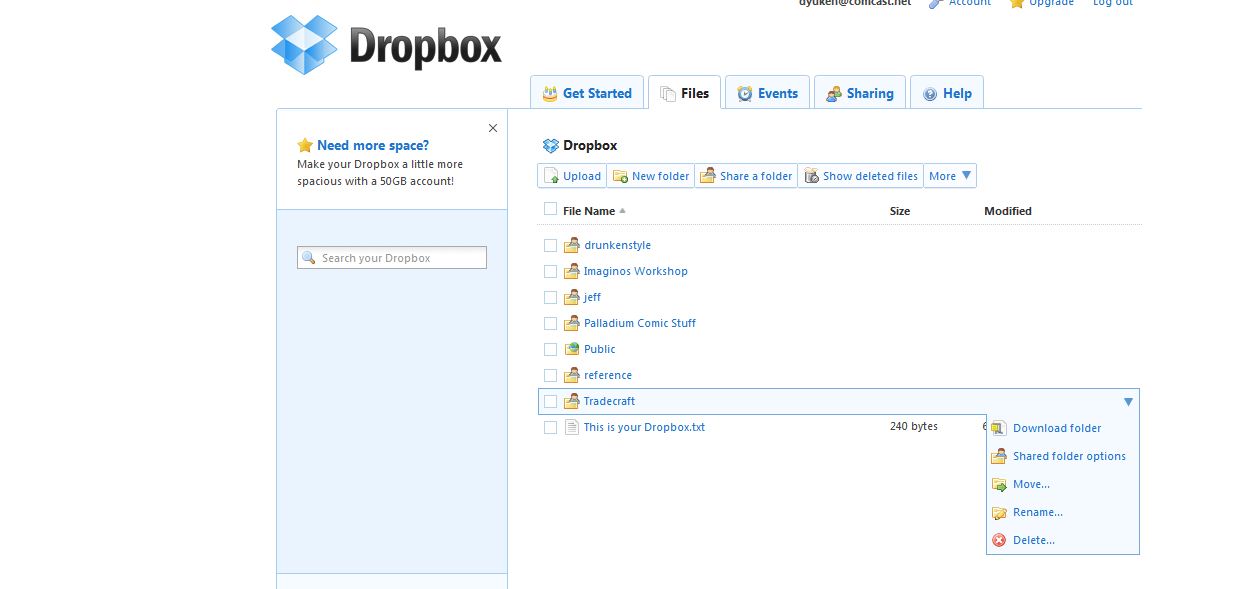
DROPBOX
Wordpad comes with windows, however, If you need a copy of Stickynotes and only have Windows XP then download a copy for free at
For Dropbox go to https://www.dropbox.com.
The key is to stay organized and these tools can help with that and the collaboration process.
Next we will talk CELTX and the process of condensing that idea into an outline and then a script.
I will also talk about some of the books that are helping us to become better writers.
Mark.
Sunday, November 6, 2011
Inside the Laboratory:
Behind the Scenes at Imaginos Workshop
Part III – Laying
out the Thumbnails and Layouts
Once we have the idea and the
details fleshed out for the story, the world it inhabits and the characters then
it is off to the thumbnails. This is the
hardest part of the creation process for most of us…except Mark.
The reason is that now we have
all this material to play with but the key is to organize it into a good
story. This is where we often have the
greatest creative differences but not in a bad way. This is where we really try to make sure we
have no holes in the story or commit the same creative sins that others
do. Having four sets of eyes on each
project goes a long way towards making sure that we’re not being lazy and
keeping each other honest when it comes to story details.
Mark is always the first person
to ask “Why?” for anything that Joe, Jon or I bring up on a particular
project. He does this to make sure we
put the work into that specific point and if we can explain it properly then he’s
in full support of it. There are times
where we cannot explain our points and we end up realizing that damn we need to
put more thought into this.
A prime example of this process
involved a project that Jon and I have been working on. I wanted to give one of the characters a set
of brass knuckles and was completely infatuated with the idea. Mark simply asked why and when I couldn’t
properly explain it he had managed to demonstrate that I was falling into the
same traps that other creators did. I
was putting things in the story just for the ‘cool’ or ‘sweetness’ factor and
that is a cardinal sin, at least for us.
He was pretty patient in listening to me argue the point until the light
bulb went off in my head. We then went
back and worked on the idea and found a proper way to introduce it, which meant
a lot to us. There are times when we pose the same question
to Mark and he appreciates the fact that we ask because it keeps him on his
toes as well.
The thumbnails and layouts are
very important to any story whether it’s a comic, movie, video game or a
book. Well for movies they’re called
storyboards and we only do that for ourselves since we can’t directly produce
them yet. Here we get an idea of how the
story flows and what areas need to be emphasized in order to tell a good
story.
I’m notorious for using 3x5 note
cards and drawing stick figures (since that’s my skill level) when it comes to
layouts and thumbnails. Mark, Joe and
Jon take great joy in ridiculing my Luddite ways but all in good fun. The fact that we all work well together is
because we don’t hold back. If one of us
sees something that doesn’t make sense or we don’t like we simply say it. Ego and pride always go out the door for us
because we don’t have time for it not when we’re in the business of creating
they simply get in the way. Joe, Jon,
Mark and I take turns rotating on the one voice of dissent which helps because
this way it doesn’t feel like one person is constantly playing ‘Debbie Downer’.
All serious creators go through the layout
& thumbnail process but where we try to excel is making sure that we do not
create or allow any holes in the story to make it to the final process. By the time we’re ready to write the final
script for a particular project we’re confident that all the major flaws have
been corrected. Now we can focus on the
writing and refining process so that we’re ready to deliver a story that people
can truly enjoy. The one key thing we emphasize
at Imaginos Workshop is that while not everyone will like our stories no one
will ever be able to say we were lazy or didn’t think our stories through.
Ok everyone now you have a basic
idea of how things work at Imaginos Workshop and this way when you see us
releasing things you’ll know what went into it.
Please stay tuned because I’m sure we’ll have some behind the scenes
videos coming out soon too. Take care
everybody!
Nik
Subscribe to:
Posts (Atom)